
Monthly Roundup: August

Portfolio New and Changes
Over the past month, Emerson Electric has been busy making two bolt on acquisitions. The company acquired a Swiss company called Afag Holding AG, which specializes in electric linear motion solutions. The terms of the acquisitions was not disclosed, and the company will be part of EMRs Discrete Automation Segment.
The second acquisition was a German company called Flexim, which is a leader in clamp-on ultrasonic flow measurements for liquids, gases, and steam. No details were provided on the terms of the deal and the company will reside in the Measurement & Analytical segment.
Capital One has sold off around $900M in office loans. No other details were provided, but I’m sure it will be brought up during their next earnings call.
There were no changes in the portfolio this month.
Super Investors
Each quarter, large investors have to publish their stock trades with the SEC. I like looking at the changes to some of my favorite value investors portfolios to see what stocks or industries they currently find interesting. Here is a summary some of the more notable portfolio changes from the super investors I follow.
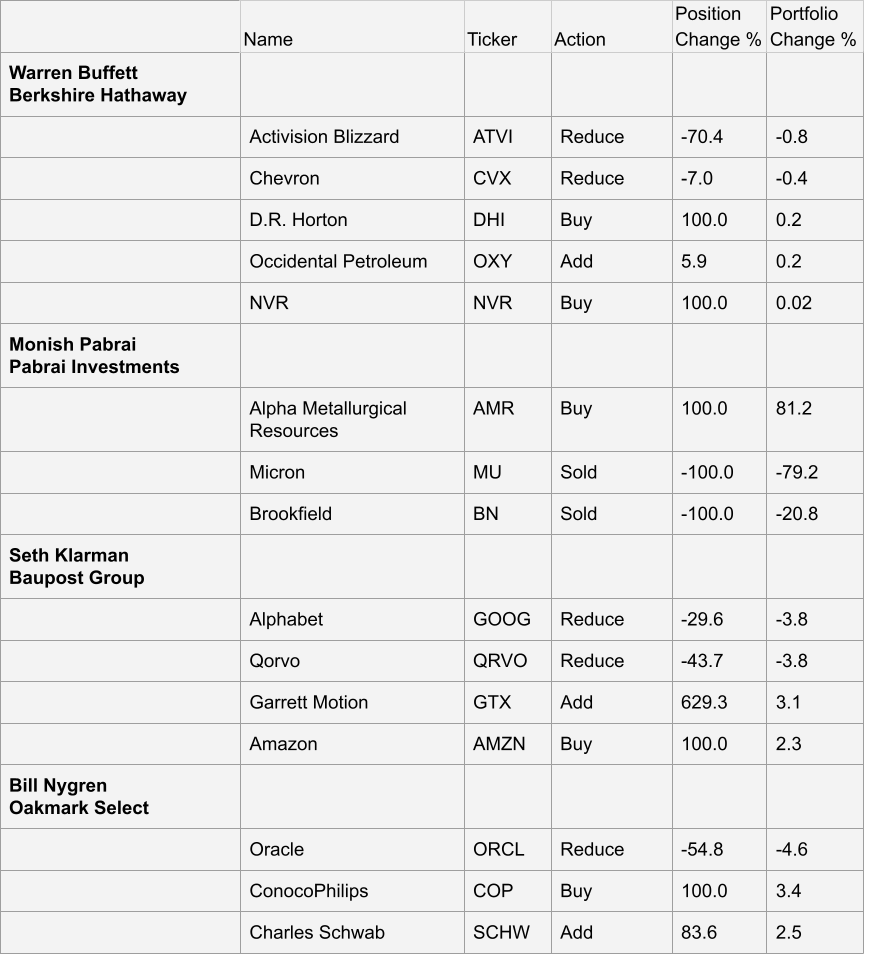
It is always interesting to see what Buffett (or oftentimes Ted/Todd) are up to. Buffett bought a large stake in Activision Blizzard as a merger arbitrage since Microsoft is trying to acquire them. This deal has been quite controversial due to regulatory concerns, and it looks like Buffett has bowed out by greatly reducing his stake in ATVI. Next, it looks like Buffett has continued the trend to sell of a bit of his Chevron position in favor of Occidental.
The other interesting portfolio change is surely from Ted/Todd, where they bought into a couple of homebuilders. Many of the homebuilding stocks trade at all time highs even though the housing market is funky. The housing market is odd right now with high interest rates lowering demand, but also supply from people who currently have low rate mortgages. Despite this, homebuilding companies have had surprisingly good earnings the past few years.
Next is Monish Pabrai’s fund, who is known for having concentrated positions but it the figures are misleading since he owns international stocks that are not part of the SEC filing. Monish sold completely out of the large positions of Micron and Brookfield in favor of a metallurgical coal company. AMR is also trading near all time highs and from the casual observer, appears to be at peak earnings for the economic cycle. It would be interesting if Monish discusses this stock in an interview soon.
Seth Klarman often buys quality companies, so I like to follow his portfolio. Nothing too controversial here, he sold off some Google and Qorvo, then bought Amazon. He also greatly increased his position in the turbocharger maker Garrett Motion.
Finally, Bill Nygren runs a pretty concentrated portfolio of large cap value stocks. Last quarter he trimmed Oracle, and bought the oil company Conoco-Philips. Interestingly, Bill increased his position in Schwab, which has been caught up in this years banking drama.
Shareholder Wealth Enhancement, 1926 to 2022
I recently stumbled upon a paper from Hendrik Bessembinder where he studies how much wealth individual companies have created or destroyed for shareholders on a data set going back to 1926. Over this time period, publicly listed companies have increased shareholder wealth by more than $55 trillion. On the flip side, many companies have reduced wealth over the period to a tune of of $9 trillion. More specifically, the data shows that of the 28,114 companies in the data set, 16,481 or 58% of the total reduced shareholder wealth.
Looking at the companies that created the most shareholder wealth we find Apple ($2.68T), Microsoft ($2.09T), Exxon Mobile ($1.22T), Alphabet ($1.0T), and Amazon ($764B). The following are some of the biggest wealth destroyers: Worldcom (-$102B), Rivian (-$91.6B), Deutchse Bank (-$47.3B), Coinbase (-$44.6B), DoorDash (-$31.9B), Airbnb (-$27.5B).
The last insights from the paper that I’ll mention is Bessembinder’s study on the concentration of the share wealth creators. Apple was responsible for 4.86% of all shareholder wealth created since 1926. The top three creators of wealth account for almost 11% of the total over the entire period. The paper finds that the amount of companies that have created the wealth has become more concentrated over the past few years.
My first take away from this paper is that I simply think these statistics are interesting. It seems counter-intuitive that almost 60% of public companies end up reducing wealth. I think it is interesting that some of the largest creators of wealth are the large tech companies like Apple, Microsoft, Amazon. These tech companies operate in a winner-take-all environment where they do not have much competition, allowing them to grow into trillion dollar companies. Another aspect could be how the market is valuing these tech companies. I’m not sure if these companies are over valued, but if earnings multiples did come down, these companies would dramatically impact the market since they make up such a large share of it.
This study provides an illustration of why buying index funds can be a good idea, since the index eventually drops the bad companies that fall into the 60% of wealth destroyers. As for stock pickers, if you own a stock for the long term then you need to watch out to make sure it is a quality business. Even then, you have to monitor the business for signs of reduced competitive advantage or technological disruption. Regarding value investors, despite most stocks destroying wealth, I’m sure a lot of them have moments of trading at valuations temporarily below fair value that revert bank to a reasonable level.