

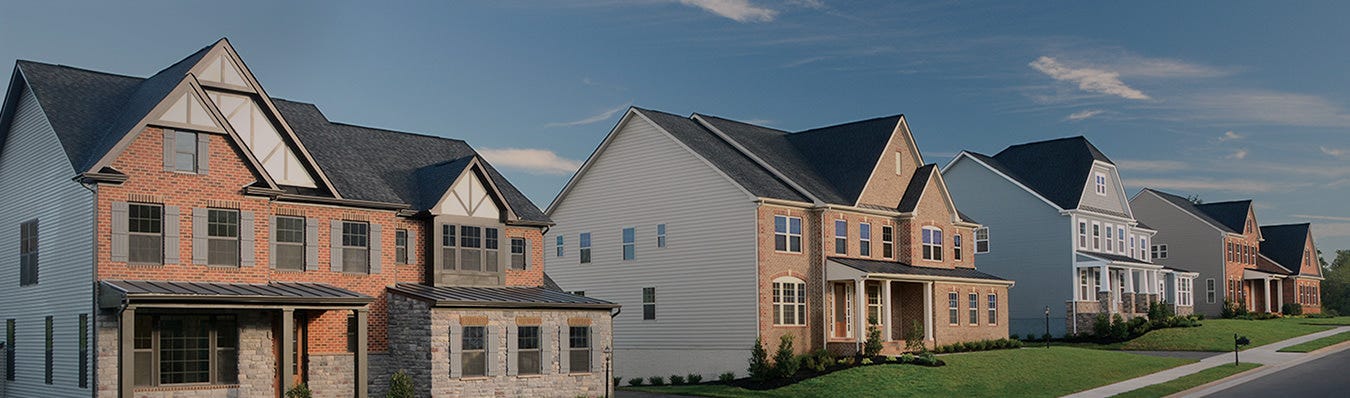
In this weeks Capital Allocation Snapshot, I’m looking at NVR, a homebuilder with a market capitalization around $21B. Most homebuilders spend a lot of capital on buying land, then wait for a good time to build the houses which ties up a lot of cash. NVR sidesteps this problem by using options contracts to acquire land so they only spend the money once they are ready to build. Also, recently someone at Berkshire bought a few homebuilder stocks, with NVR being one of the names. In this post I’ll summarize NVRs cash flow statement to get an idea of how they are allocating capital.
Cash Flow Summary
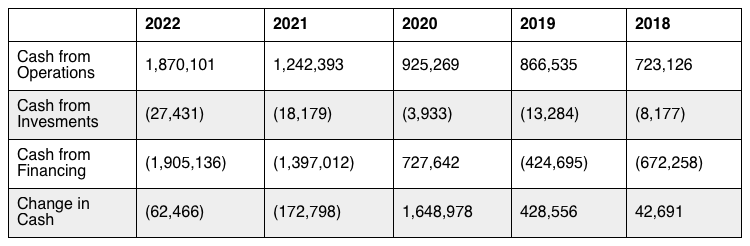
In order to see how NVR allocates their capital, first lets see how much profits they are generating. Over the last five years, the company has grown its cash from operations at a high rate, going from $723M to almost $1.9B. This growth was achieved in spite of the supply chain challenges during COVID, and the increase in interest rates that started in 2022.
NVRs cash from investments is much smaller than their cash from operations. These values fluctuate a bit, with the lowest investment spend coming in at $4M, up to $27M in 2022.
In four out of the five years, NVR has had cash outflows when it comes to financing. The only exception was 2020 where the company received $730M. In several of the years, NVR has seen cash outflow for financing that are close to, or surpass its cash from operations.
Cash from Investments
NVRs cash from investments is pretty simple, with the main line item being capital expenditures. The company has spent around $20M a year in capex over the last five years. Comparing NVRs capex spend to its cash from operations shows the company spends less than 3% of its cash flow on capex. This is a very small ratio, but it makes sense because land and brand new houses do not need much capital expenditures.

Cash from Financing
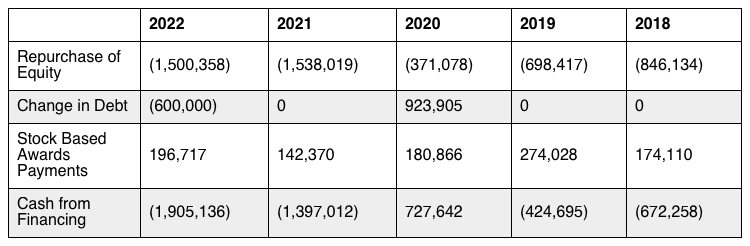
Turning to NRVs cash from financing, we see that they only had debt related activity in 2020 and 2022. Back in 2020, the company issued $900M in debt, then in 2022 they paid off $600M. NVRs debt-to-equity ratio is 0.22, and their debt-to-EBITDA ratio is 0.39. Both of these debt metrics indicate NVR has very little debt.
As far as shareholder returns go, NVR has paid no dividends, instead repurchased stock over the last five years. The stock buybacks have varied quite a bit, with about $850M being spent in 2018 followed by a dip to $700M the next year. In 2020, repurchases declined even further to $370M. Then NVR ramped up the buybacks the last two years, doing about $1.5B each year.
Comparing NVRs buybacks to its cash from operations gives us some insight on how much of the profits the company is returning to shareholders. NVR has returned over 80% of its cash from operations to shareholders each year except for 2020. Interestingly, in 2018 and 2021, NVR returned over 100% of its operating cash flow to shareholders, dipping into the company’s cash reserves. These share repurchases are the dominant factor in NVRs capital allocation. Clearly the company does not need much capital to operate the business, so pretty much all profits are returned to shareholders.
The last line item has to do with NVR issuing treasury stock to settle stock option and RSU vesting. This figure does not have much to do with capital allocation, but it is a non-trivial amount of cash.
Conclusion
After looking at NVRs cash flow statement, their capital allocation strategy is pretty basic. The company generates a healthy amount of cash from its operations. NVR then returns nearly all of this cash to shareholders through buybacks. It was surprising to me that NVR spent hardly anything on capital expenditures. One reason for this is that NVR pioneered the concept of buying options on land and developing it when the time is right, whereas most homebuilders outright buy the land then have to sit on this expensive asset.
Whether it is a good capital allocation move for NVR to repurchase so much stock depends on whether the company can use the cash better somewhere else, and if the repurchased stock is undervalued. Since NVR seems to have a capital light business model compared to other homebuilders, they do not need as much cash to run the business. NVRs stock has been climbing ever higher the past few years, and it has been trading at low earnings multiples. This suggests the company could be undervalued. The caveat is that homebuilders are cyclical stocks, so its earnings could be abnormally high at the top of the cycle.