

HEICO is a $21B company that is known for manufacturing replacement parts for the aviation industry. The company is a FinTwit favorite, especially with people interested in stocks that retain earnings and have a long history of profitable growth. This is because HEICO is a serial acquirer, constantly adding smaller companies to its portfolio. In this capital allocation snapshot, I’ll summarize HEICO’s financials to see how the company is using its cash for acquisitions and other items.
Cash Flow Summary
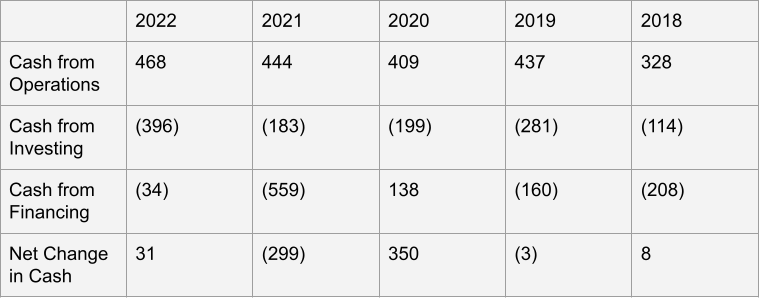
Taking a high level view of HEICO’s cash flow statement will give us some context on how the company allocates its capital. First is the company’s cash from operations, that had a 30% increase from 2018 to 2019. Since 2019 HEIs operating cash flow has hovered around around $440M. Looking at the last five years, it does appear that HEICO generates pretty steady income.
Next is HEICO’s cash from investing activities. The company on average spends about $200M a year in investments. The lowest amount was in 2018 at $114M, while 2022 saw the peak at $396M. However the investment spend bounced around during the five year period.
HEI’s cash from financing bounces around quite a bit. In 2020 the company raised $138M, while every other year they had cash outflows. HEICO spent the most on financing in 2021 with $559M leaving the company.
Looking at the overall change in cash, we see that HEICOs cumulative cash balance has not gone anywhere over the last five years.
Cash from Investing
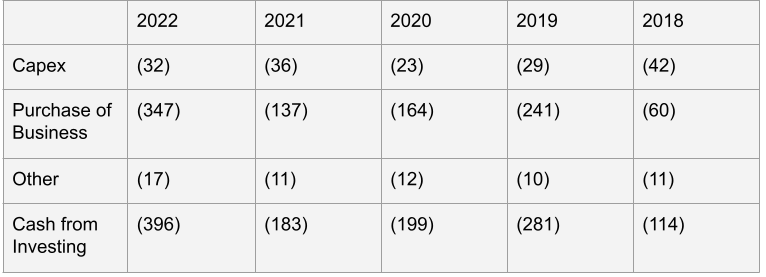
HEICO’s cash from investing is pretty straightforward with two main line items, capex and (mostly) purchase of businesses. The company typically spends around $30M a year in capital expenditures. This capex spend is less than 10% of the cash from operations, which suggests HEICO’s operations are not very capitally intensive. Since HEI is a manufacturing company, I would have expected capex to be a bit higher.
One of HEICO’s main capital allocation moves is to continuously acquire other businesses. The company typically spends around $200M a year in buying businesses. This average value is about 45% of HEIs cash from operations. Whenever looking at serial acquirers, it is important to see if the acquisitions are made at reasonable prices. Often times companies over pay for acquisitions and hope for synergies to pay off that many times do not. However, diving into the performance of HEICO’s acquisitions is work for another day.
The “other” line item mostly deals with “Investments related to HEICO Leadership Compensation Plan” from the company’s annual report. This does not sound like it has to do with capital allocation, but it does seem odd.
Cash from Financing
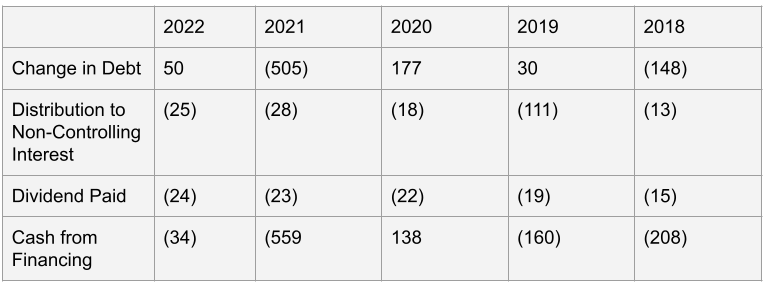
Looking at HEICO’s change in debt shows that the company goes back and forth issuing debt and paying it down. The largest issuance of debt came in 2020 at $177M, while the following year HEI paid down $505M in debt. Another year of debt pay down occurred in 2018 at nearly $150M. The other years saw slight increases in debt. Since HEICO is making many acquisitions, the debt is most likely being used to buy businesses.
HEICO’s long term debt-to-equity ratio is 0.11, and their debt-to-EBITDA is 0.52. Both of these leverage metrics are low, showing that even though HEICO issues some debt, it is not a large part of their capital structure.
The next line item is for the payment of cash to non-controlling interests. According to HEIs annual report, Lufthansa Technik AG has a 20% stake in HEICO. This line item reflects the dividends paid to the non-controlling interests. In most years these distributions are pretty small, except for the $111M payout in 2019. Interestingly these distributions are about the same amount as the dividend HEI pays to its common shareholders.
Speaking of dividends, HEICO has been steadily increasing their dividend. Comparing HEIs dividend payout to its cash from operations shows a 5% payout ratio. This ratio is very low. The low payout ratio indicates that HEICO is keeping nearly all of its profits within the business in order to fund growth.
Conclusion
The story of HEICO’s capital allocation looks to be pretty simple. The company steadily generates cash from its operations, and uses that cash and some debt to make acquisitions. As mentioned previously, often times corporations are terrible at doing mergers and acquisitions by overpaying and destroying shareholder wealth. However, HEICO has had a history of growing revenue nicely (although growth has plateaued the last few years) so maybe they are good at being serial acquirers. Since HEIs growing so much, it makes sense to reinvest the profits by buying more companies. That being said, HEICO pays such a small amount of a dividend that I think it would make more sense to just retain all earnings instead of paying a paltry $0.28 per share dividend on a stock that is trading around $175.